Ƶ

Digital Patient Podcast

TDP 192: UCLA Health’s CMIO Dr. Eric Cheng: Applying Randomization to Informatics, Creating AI-Enabled, Personalized EHR Experiences for Every Clinician, and Advancing Equity Through Accurate Data

September 18, 2025
By
seamless

Subscribe on: | | | | |

On this episode of The Digital Patient, Dr. Joshua Liu, Co-founder & CEO of Ƶ, and colleague, Alan Sardana, chat with Dr. Eric Cheng, CMIO at UCLA Health, about "Applying Randomization to Informatics, CreatingAI-Enabled,Personalized EHR Experiences for Every Clinician, Advancing Equity Through Accurate Data, and more..." Click the play button to listen or read the show notes below.

Audio:

Guest(s):

  • Dr. Eric Cheng, Chief Medical Informatics Officer at UCLAHealth
  • Dr. Joshua Liu, Co-founder & CEO at Ƶ

Episode 192 - Show Notes:

[00:00:07] Episode preview

[00:04:30] Why Dr. Cheng chose healthcare for his interests in science and its impact on society;

[00:05:18] How Oliver Sacks' books inspired him to pursue neurology;

[00:06:40] How analyzing the United States Department of Veterans Affairs national database led him to informatics;

[00:09:55] Why AI won’t remove the need for discrete data in EHRs yet;

[00:011:55] “There’s no substitute for randomization” and how Dr. Cheng introduced randomization to health IT;

[00:13:20] Challenges of applying RCT methodology to informatics interventions;

[00:16:31] How UCLA randomized 250 physicians across two ambient scribe vendors;

[00:19:47] Handling self-selection bias with crossover randomization design;

[00:21:56] Surprising result: ambient scribes didn’t reduce time, but lowered cognitive load;

[00:26:13] Plans to track long-term scribe impact through burnout and satisfaction surveys;

[00:27:14] How notes became cognitively taxing as more stakeholders claimed ownership;

[00:31:14] The future of AI-personalized note views for each type of EHR reader;

[00:32:10] Why AI can’t overcome omitted variable bias without complete data;

[00:36:28] Concern that overreliance on AI could stunt medical intuition in trainees;

[00:38:59] Building the resident informaticist program at UCLA;

[00:40:13] Why the goal is informatics literacy, not producing only informaticists;

[00:41:49] Winning UCLA’s Justice Leadership Excellence Award for advancing equity through data;

[00:45:49] “You have to start somewhere” – pushing patients to self-report accurate demographics;

Fast 5 Lightning Round:

  1. What is your favorite book or book you’ve gifted the most?
    The Digital Doctor by Robert Wachter; also Klara and the Sun by Kazuo Ishiguro – about an AI-based robot with hyper observation skills but no full fund of knowledge.
  2. If you could instantly master any skill, what would it be?
    Networking (with people) more quickly.
  3. Would you rather have Super strength, super speed, or the ability to read people’s minds?
    Reading minds – “an essential skill if you’re a leader.”
  4. What is something in healthcare you believe that others might find insane?
    That the sacred one-on-one doctor-patient model isn’t always best and that sometimes many-to-one or one-to-many clinics could be better.
  5. What is the last movie or TV show you saw?
    K-Pop Demon Hunter; also recommends the documentary AlphaGo as a great illustration of AI.

The Digital Patient has been recognized as Feedspot's . Thank you to our listeners for making this happen!
TDP 192: UCLA Health’s CMIO Dr. Eric Cheng: Applying Randomization to Informatics, Creating AI-Enabled, Personalized EHR Experiences for Every Clinician, and Advancing Equity Through Accurate Data

Posted by:
seamless
on
September 18, 2025

Subscribe on: | | | | |

On this episode of The Digital Patient, Dr. Joshua Liu, Co-founder & CEO of Ƶ, and colleague, Alan Sardana, chat with Dr. Eric Cheng, CMIO at UCLA Health, about "Applying Randomization to Informatics, CreatingAI-Enabled,Personalized EHR Experiences for Every Clinician, Advancing Equity Through Accurate Data, and more..." Click the play button to listen or read the show notes below.

Audio:

Guest(s):

  • Dr. Eric Cheng, Chief Medical Informatics Officer at UCLAHealth
  • Dr. Joshua Liu, Co-founder & CEO at Ƶ

Episode 192 - Show Notes:

[00:00:07] Episode preview

[00:04:30] Why Dr. Cheng chose healthcare for his interests in science and its impact on society;

[00:05:18] How Oliver Sacks' books inspired him to pursue neurology;

[00:06:40] How analyzing the United States Department of Veterans Affairs national database led him to informatics;

[00:09:55] Why AI won’t remove the need for discrete data in EHRs yet;

[00:011:55] “There’s no substitute for randomization” and how Dr. Cheng introduced randomization to health IT;

[00:13:20] Challenges of applying RCT methodology to informatics interventions;

[00:16:31] How UCLA randomized 250 physicians across two ambient scribe vendors;

[00:19:47] Handling self-selection bias with crossover randomization design;

[00:21:56] Surprising result: ambient scribes didn’t reduce time, but lowered cognitive load;

[00:26:13] Plans to track long-term scribe impact through burnout and satisfaction surveys;

[00:27:14] How notes became cognitively taxing as more stakeholders claimed ownership;

[00:31:14] The future of AI-personalized note views for each type of EHR reader;

[00:32:10] Why AI can’t overcome omitted variable bias without complete data;

[00:36:28] Concern that overreliance on AI could stunt medical intuition in trainees;

[00:38:59] Building the resident informaticist program at UCLA;

[00:40:13] Why the goal is informatics literacy, not producing only informaticists;

[00:41:49] Winning UCLA’s Justice Leadership Excellence Award for advancing equity through data;

[00:45:49] “You have to start somewhere” – pushing patients to self-report accurate demographics;

Fast 5 Lightning Round:

  1. What is your favorite book or book you’ve gifted the most?
    The Digital Doctor by Robert Wachter; also Klara and the Sun by Kazuo Ishiguro – about an AI-based robot with hyper observation skills but no full fund of knowledge.
  2. If you could instantly master any skill, what would it be?
    Networking (with people) more quickly.
  3. Would you rather have Super strength, super speed, or the ability to read people’s minds?
    Reading minds – “an essential skill if you’re a leader.”
  4. What is something in healthcare you believe that others might find insane?
    That the sacred one-on-one doctor-patient model isn’t always best and that sometimes many-to-one or one-to-many clinics could be better.
  5. What is the last movie or TV show you saw?
    K-Pop Demon Hunter; also recommends the documentary AlphaGo as a great illustration of AI.

The Digital Patient has been recognized as Feedspot's . Thank you to our listeners for making this happen!

Recent news from Ƶ

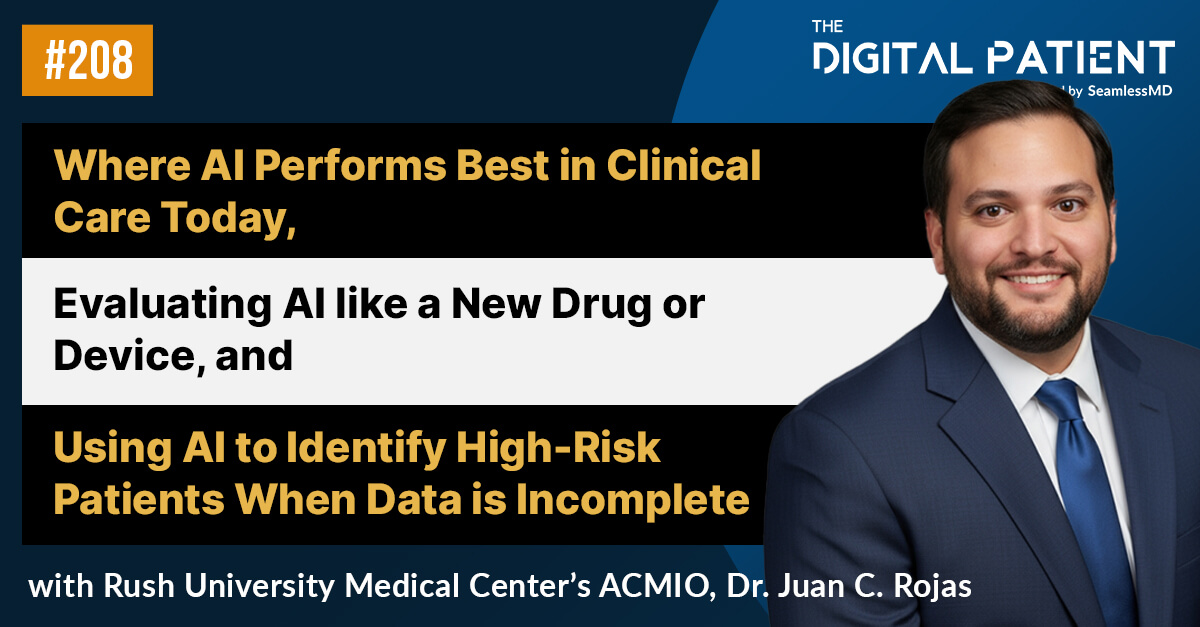
TDP 208: Rush University Medical Center’s ACMIO Dr. Juan C. Rojas: Where AI Performs Best in Clinical Care Today, Evaluating AI like a New Drug or Device, and Using AI to Identify High-Risk Patients When Data is Incomplete
December 16, 2025

TDP 208: Rush University Medical Center’s ACMIO Dr. Juan C. Rojas: Where AI Performs Best in Clinical Care Today, Evaluating AI like a New Drug or Device, and Using AI to Identify High-Risk Patients When Data is Incomplete

Learn More
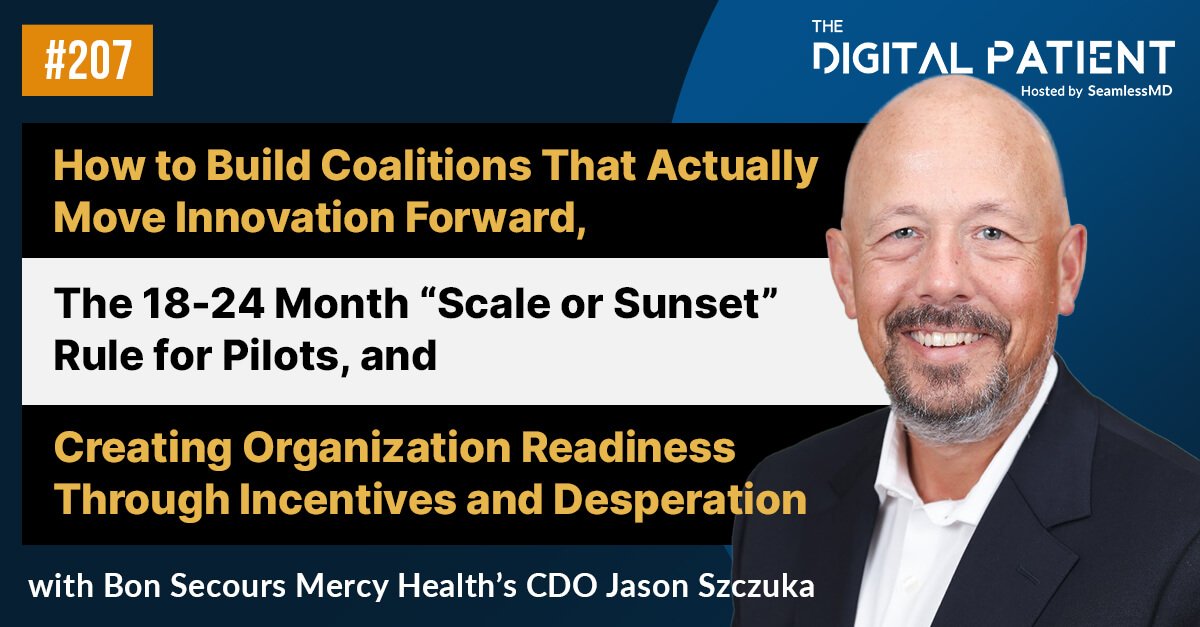
TDP 207: BSMH’s Jason Szczuka: Building Coalitions That Actually Move Innovation Forward, The 18-24 Month “Scale or Sunset” Rule for Pilots, and Creating Organization Readiness Through Incentives and Desperation
December 11, 2025

TDP 207: BSMH’s Jason Szczuka: Building Coalitions That Actually Move Innovation Forward, The 18-24 Month “Scale or Sunset” Rule for Pilots, and Creating Organization Readiness Through Incentives and Desperation

Learn More
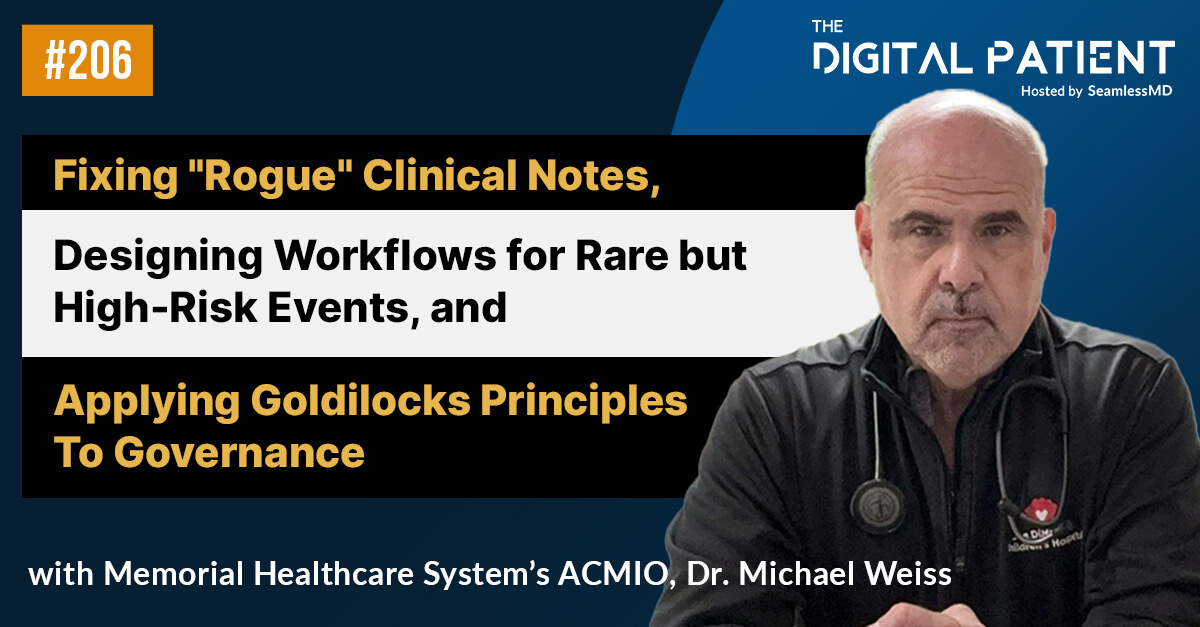
TDP 206: MHS’ ACMIO Dr. Michael Weiss: Fixing "Rogue" Clinical Notes, Designing Workflows for Rare but High-Risk Events, and Applying Goldilocks Principles to Governance
December 9, 2025

TDP 206: MHS’ ACMIO Dr. Michael Weiss: Fixing "Rogue" Clinical Notes, Designing Workflows for Rare but High-Risk Events, and Applying Goldilocks Principles to Governance

Learn More